Home › Species › Cheetah facts
Cheetah facts: speed, hunting, range and conservation status
The cheetah (Acinonyx jubatus) is the fastest land animal, a slender daytime hunter of open country that sprints in short bursts after gazelles and impala. It is not a roaring cat and sits outside the genus Panthera. Listed as Vulnerable on the IUCN Red List (assessed 2021; amended publication 2024), it numbers about 6,517 mature individuals, mostly in southern and eastern Africa, plus a critically endangered remnant in Iran.
Jump to: Quick facts | Speed | Built for speed | Hunting | Social life | Range | Status
Quick facts
| Scientific name | Acinonyx jubatus |
|---|---|
| Weight | 23 to 65 kg |
| Head and body length | 113 to 140 cm, plus a 60 to 84 cm tail |
| Lifespan | Up to about 14 years in the wild |
| Litter size | 1 to 6 cubs |
| Range | Mainly southern and eastern Africa; Sahara; Iran |
| IUCN Red List | Vulnerable, assessed 17 May 2021 (amended 2024; Asiatic cheetah: Critically Endangered) |
Size and lifespan ranges are those listed by the IUCN SSC Cat Specialist Group and cover both sexes and all populations.
How fast is a cheetah?
Two records get confused. A 2013 collar study in Botswana measured a wild hunting peak of 25.9 m/s (93 km/h, 58 mph) across 367 runs, while the average run topped out at 14.9 m/s. A straight line timing of a captive cheetah reached 29 m/s (Sharp 1997). The IUCN Cat Specialist Group page, opened 20 November 2026, says cheetahs reach speeds up to 29 m/s and take strides up to 7 m. It does not state a 300 m chase limit. Our post how fast is a cheetah sets the two studies side by side, including a Kgalagadi collar study that peaked at 18.94 m/s.
What makes a cheetah so fast?
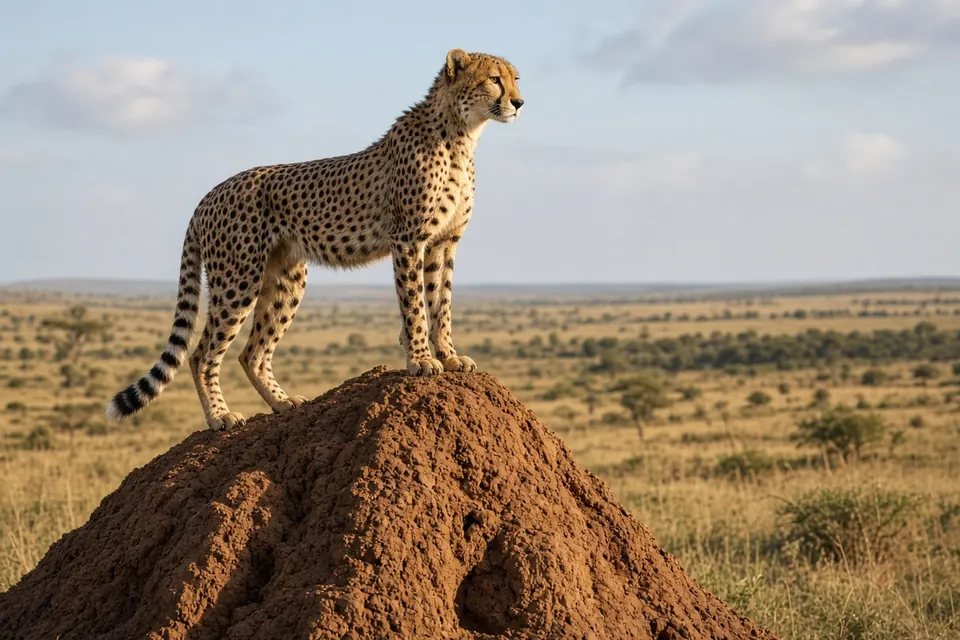
- Long legs, big thigh muscles and a very flexible spine allow strides of up to about 7 m.
- Semi retractable claws grip the ground like running spikes.
- A long tail, about half the head and body length, helps with balance in turns.
- Enlarged lungs, heart and nasal passages help it recover after a sprint.
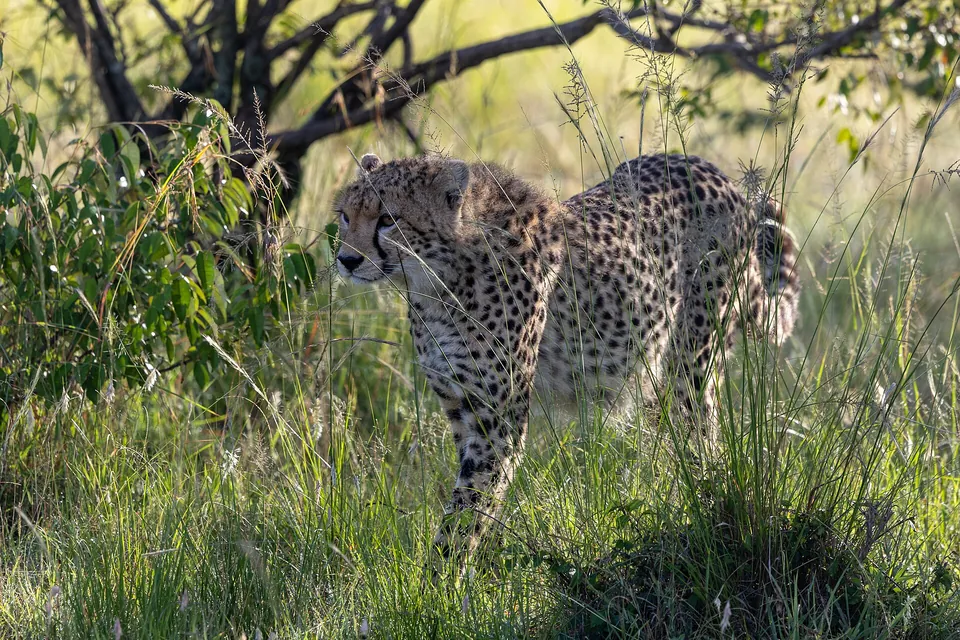
Cheetahs also have black "tear marks" running from the inner eye to the mouth, and solid round spots rather than rosettes. Zoos and the Cheetah Conservation Fund present the marks as a daytime glare aid (a hypothesis, not a lab proof); see why do cheetahs have black tear marks?
How do cheetahs hunt?
Cheetahs usually stalk first, then sprint over a short distance and trip or knock the prey off balance before a suffocating bite to the throat. They prefer prey of about 10 to 56 kg: Thomson's gazelle on East African plains, impala in woodland, springbok and young kudu in southern Africa. Cheetahs hunt mainly by day, which helps them avoid lions and hyenas, but those larger predators still steal kills and kill cubs. Our article how do cheetahs live alongside lions and hyenas? explains how cheetahs avoid them and eat quickly or keep watch at kills. They abandon most hunts, but not because they overheat: free living measurements put body temperature at about 38.4°C when chases end. See do cheetahs abandon hunts because they overheat? Cheetahs are not obligate drinkers and can get much of their moisture from prey.
Where do cheetahs live?
Cheetahs live in savanna, grassland, dry woodland and desert. Strongholds are in Namibia and Botswana and in Kenya and Tanzania, with very sparse populations in the Sahara. Remarkably, about two thirds of cheetahs live outside protected areas, often on farmland, partly because lions and hyenas are scarcer there. In Asia, the Asiatic cheetah survives only in Iran, where fewer than 50 mature individuals are thought to remain. In 2022 India began bringing cheetahs from southern Africa to Kuno National Park in an effort to restore the species there.
How many cheetahs are left?
We rechecked the global IUCN Red List assessment on iucnredlist.org on 19 November 2026. The species remains Vulnerable under criteria A4b; C1. The assessment date is still 17 May 2021; the current Red List entry is an amended 2024 version of that assessment (updated distribution map), citing about 6,517 mature individuals and a decreasing population trend across 33 locations.
A major 2017 study led by Sarah Durant estimated about 7,100 adult and adolescent cheetahs (around 6,500 mature individuals) in 33 subpopulations, occupying about 9 percent of the species' historical range. Only two subpopulations exceed 1,000 mature individuals, and most of those whose trend could be assessed are declining. Threats include habitat loss and fragmentation, conflict with livestock and game farmers, prey depletion, road deaths and the illegal trade in live cubs and skins. Cheetahs also have very low genetic diversity, the legacy of ancient population bottlenecks.
Frequently asked questions
Is a cheetah a big cat?
In the strict sense no: big cats are the roaring cats of the genus Panthera, and the cheetah belongs to its own genus, Acinonyx. In everyday use the cheetah is usually included as a big cat, as it is on this site.
Can cheetahs roar?
No. Cheetahs purr and make chirping and other calls, but they cannot roar.
What is the top speed of a cheetah?
The fastest wild hunting run measured with collars was 25.9 m/s, about 93 km/h or 58 mph (Wilson et al. 2013, Botswana). A straight line timing of a captive cheetah reached 29 m/s (Sharp 1997). The IUCN Cat Specialist Group page, checked 20 November 2026, says cheetahs reach speeds up to 29 m/s.
Why do cheetahs have black tear marks?
Zoos and the Cheetah Conservation Fund describe the marks as reducing sun glare for daytime hunting; Smithsonian phrases this as something the marks may do. It is a hypothesis. See why do cheetahs have black tear marks?
Do lions kill cheetahs?
Yes. Lions and spotted hyenas kill cheetah cubs and sometimes adults, and often steal cheetah kills. Cheetahs cope mainly by avoiding them; see how cheetahs live alongside lions and hyenas.
Do cheetahs abandon hunts because they overheat?
No. Free living cheetahs in Namibia ended chases at about 38.4°C, within their normal daily range. Heat rises more after a kill than during the sprint; see the research summary.
What is the cheetah's IUCN status?
Vulnerable, assessed 17 May 2021 (amended Red List publication 2024). Rechecked on iucnredlist.org on 19 November 2026.
Cite this page
APA: BigCatWise. (2026, November 20). Cheetah facts. https://bigcatwise.com/cheetah.html
MLA: "Cheetah facts." BigCatWise, 20 Nov. 2026, bigcatwise.com/cheetah.html.
Chicago: BigCatWise. "Cheetah facts." Last modified November 20, 2026. https://bigcatwise.com/cheetah.html.
Please check the date you accessed the page and adjust to your teacher's or journal's style guide.
Sources
- IUCN SSC Cat Specialist Group: Cheetah
- Durant et al. (2017) The global decline of cheetah and what it means for conservation, PNAS
- Wilson et al. (2013) Locomotion dynamics of hunting in wild cheetahs, Nature 498
- Sharp (1997) Timed running speed of a cheetah (Acinonyx jubatus), Journal of Zoology 241: 493-494. DOI 10.1111/j.1469-7998.1997.tb04840.x
- Wilson, Mills, Wilson, Peters, Mills, Speakman, Durant, Bennett, Marks and Scantlebury (2013) Cheetahs balance turn capacity with pace when chasing prey, Biology Letters 9: 20130620. DOI 10.1098/rsbl.2013.0620
- Smithsonian's National Zoo and Conservation Biology Institute: Cheetah
- WWF: Cheetah
- San Diego Zoo Wildlife Alliance: Cheetah
- Panthera: Cheetah
- IUCN Red List: Acinonyx jubatus, Durant et al. (assessed 2021, published 2024)
Figures are rounded summaries of the sources above. Wild populations are hard to count, so estimates change as new surveys are published.
Do cheetahs live alone?
Adult females are solitary and non territorial, raising cubs alone. Cub losses can be severe: on the Serengeti Plains only about 1 in 20 cubs was estimated to reach independence, mostly because lions and hyenas killed them, though survival was far higher in the Kgalagadi. See why do so few cheetah cubs survive? Males may live alone or in small coalitions, often brothers, and some hold small territories averaging around 30 km² that contain prey, water and access to females. Cheetahs cannot roar; they purr and make high pitched chirping calls.