Home › Big cat behavior
Big cat behavior: hunting, social life and communication
Most big cats are solitary, territorial hunters that rely on stealth and ambush. The lion is the exception, living in prides, and the cheetah is the odd one out as a daytime sprinter. All of them communicate over long distances with scent marks and calls, and mothers raise cubs alone for a year or two.
Jump to: Social life | Hunting styles | Communication | Territories | Cubs | Activity
How do big cats hunt?
| Species | Main hunting style | Typical prey |
|---|---|---|
| Lion | Group stalking and ambush; also scavenging | Wildebeest, zebra, buffalo, antelope |
| Tiger | Solitary stalk and ambush, then drags kill to cover | Deer such as chital and sambar, gaur, wild pig |
| Leopard | Close stalk and short rush; often caches kills in trees | Very broad, from hyraxes to eland |
| Jaguar | Ambush, often near water; skull piercing bite | Peccaries, capybaras, caiman, turtles, fish |
| Cheetah | Stalk then high speed chase over a short distance, by day | Gazelles, impala, springbok |
| Snow leopard | Stalk from above and chase down steep slopes | Wild sheep and goats such as bharal and ibex |
Holding on to a kill matters as much as making it. Leopards hoist about half their kills into trees, mainly to keep them from spotted hyenas; see why do leopards drag their kills into trees? for the field study of 2,032 kills.
Snow leopards are diet specialists that regularly take prey heavier than themselves: a review of 1,696 scats found they prefer Siberian ibex and blue sheep of about 55 kg. See what do snow leopards eat? for the diet research.
Jaguars are the water specialists: they swim well and, in some wetlands, live mainly on fish and aquatic reptiles. A Pantanal study found fish in 46% of jaguar scats and aquatic reptiles in 55%. See do jaguars hunt in water?
Bite force also varies a lot by species. One widely cited skull based study found the tiger and lion bite hardest in raw force, but the jaguar bites hardest relative to its own body size. See which big cat bites the hardest?
Cheetahs abandon most chases, but not because they overheat. Implanted loggers in free living Namibian cheetahs showed body temperature at chase end stayed near 38.4°C; see do cheetahs abandon hunts because they overheat? Their black facial tear marks are widely described as a daytime glare aid; that idea is a hypothesis, explained in why do cheetahs have black tear marks?
Timing matters too. Tigers are mostly nocturnal and crepuscular, and camera trap studies show they track their prey's daily schedule: in Sumatra, tiger activity overlapped strongly with muntjac and sambar deer. Near Chitwan, Nepal, tigers shared trails with people but avoided the daytime human peak. See are tigers nocturnal?
Ambush hunting means most attempts fail, so big cats need large areas with plenty of prey. A tiger, for example, is estimated to need around 50 to 60 large prey animals a year. That is why loss of prey to hunting by people is a serious threat on its own.
How do big cats communicate?
Roars and calls. Lions, tigers, leopards and jaguars can roar; a lion's roar carries over several kilometres and helps pride members find each other and warn rivals off. Leopards make a repeated rasping call often likened to sawing wood. Snow leopards and cheetahs cannot roar. Cheetahs purr and chirp. See which big cats can roar.
Scent. Big cats spray urine on trees and rocks, leave droppings in prominent places and scrape the ground with their hind feet. These marks tell neighbours who lives there, and whether a female is ready to breed. You may see a cat curl its lip while sniffing a mark; this is the flehmen response, which draws scent towards an organ in the roof of the mouth.
Visual signals. Lions' manes, ear markings on tigers (white spots on the backs of the ears) and tail postures all carry information at close range. A darker lion mane signals better nutrition and higher testosterone, and lionesses in the Serengeti preferred darker maned males; see why do male lions have manes?
How big are big cat territories?
Territory size tracks prey. Figures from the IUCN Cat Specialist Group show the range:
- Tiger: females 10 to 39 km² in prey rich Chitwan, Nepal, but 100 to 400 km² in the Russian Far East, where one male used 1,379 km².
- Lion: pride territories of 50 to 200 km² where prey is dense, up to 500 to 5,000 km² where it is scarce.
- Leopard: roughly 30 to 78 km² for males and 15 to 38 km² for females in African protected areas, but over 2,000 km² in the Kalahari.
- Cheetah: territorial males hold small territories averaging about 30 km², while non territorial cheetahs can roam over thousands of square kilometres.
Deep dives: how big is a tiger's territory? compares radio collar studies from Russia, Thailand and Bangladesh, and why do lions live in prides? explains how pride size helps lions win territorial contests.
How do big cats raise their cubs?
Cubs are born blind and helpless after a pregnancy of roughly three to three and a half months (about 103 days in tigers, 90 to 105 days in leopards). Litters are usually one to four or five cubs, and cheetahs can have up to six. Mothers hide young cubs and move them between dens. Cubs learn to hunt by watching and practising for many months; young tigers become independent at about 18 to 28 months. Cub mortality is high: in Chitwan about a third of tiger cubs die in their first year, with infanticide by males a leading cause. For cats that survive to adulthood, lifespan then varies a lot by species and by whether they live wild or in a zoo; see how long do big cats live? The lion figures are split by sex: how long do lions live in the wild versus in zoos?
Are big cats nocturnal?
Most big cats are most active from dusk to dawn, and they rest for much of the day. Activity shifts with heat, prey and people: leopards in undisturbed Gabonese rainforest were found to be largely active by day, while cats near people tend to become more nocturnal. The cheetah is the clear exception, hunting mainly in daylight, which helps it avoid lions and hyenas.
Cite this page
APA: BigCatWise. (2026, November 20). Big cat behavior. https://bigcatwise.com/behavior.html
MLA: "Big cat behavior." BigCatWise, 20 Nov. 2026, bigcatwise.com/behavior.html.
Chicago: BigCatWise. "Big cat behavior." Last modified November 20, 2026. https://bigcatwise.com/behavior.html.
Please check the date you accessed the page and adjust to your teacher's or journal's style guide.
Sources
- IUCN SSC Cat Specialist Group: Lion
- IUCN SSC Cat Specialist Group: Tiger
- IUCN SSC Cat Specialist Group: Leopard
- IUCN SSC Cat Specialist Group: Jaguar
- IUCN SSC Cat Specialist Group: Cheetah
- IUCN SSC Cat Specialist Group: Snow leopard
- Wilson et al. (2013) Locomotion dynamics of hunting in wild cheetahs, Nature 498
- San Diego Zoo Wildlife Alliance: Lion
Figures are rounded summaries of the sources above. Wild populations are hard to count, so estimates change as new surveys are published.
Do big cats live in groups?
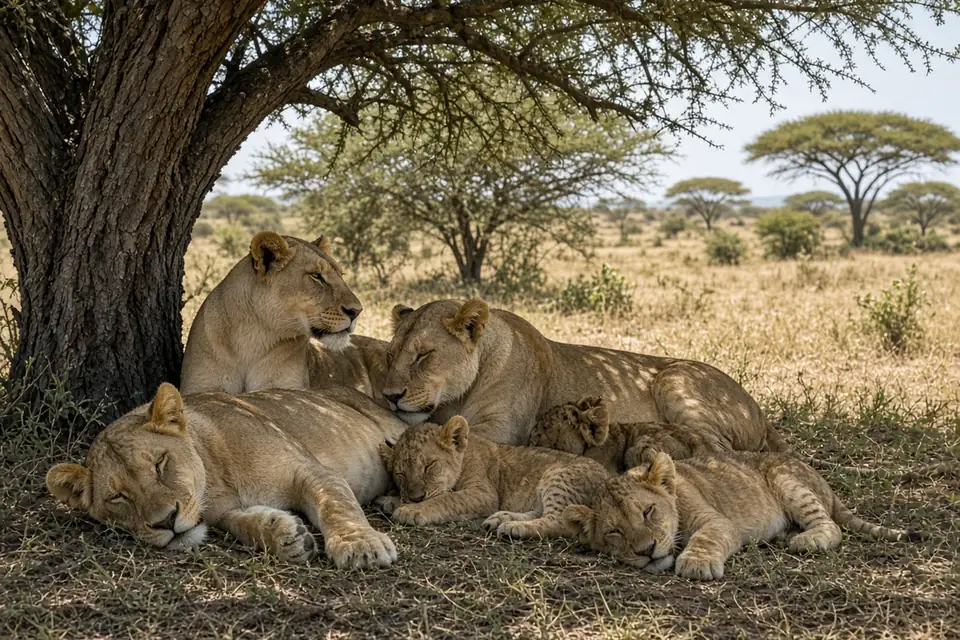
Only lions live in stable social groups. A pride is built around related females, with an average of four to six adult lionesses in Africa, plus their cubs and one or more resident males. Male lions and male cheetahs often form coalitions, frequently of brothers, which helps them win and hold territory. Tigers, leopards, jaguars and snow leopards are solitary as adults; males and females meet mainly to mate, and mothers raise cubs on their own.